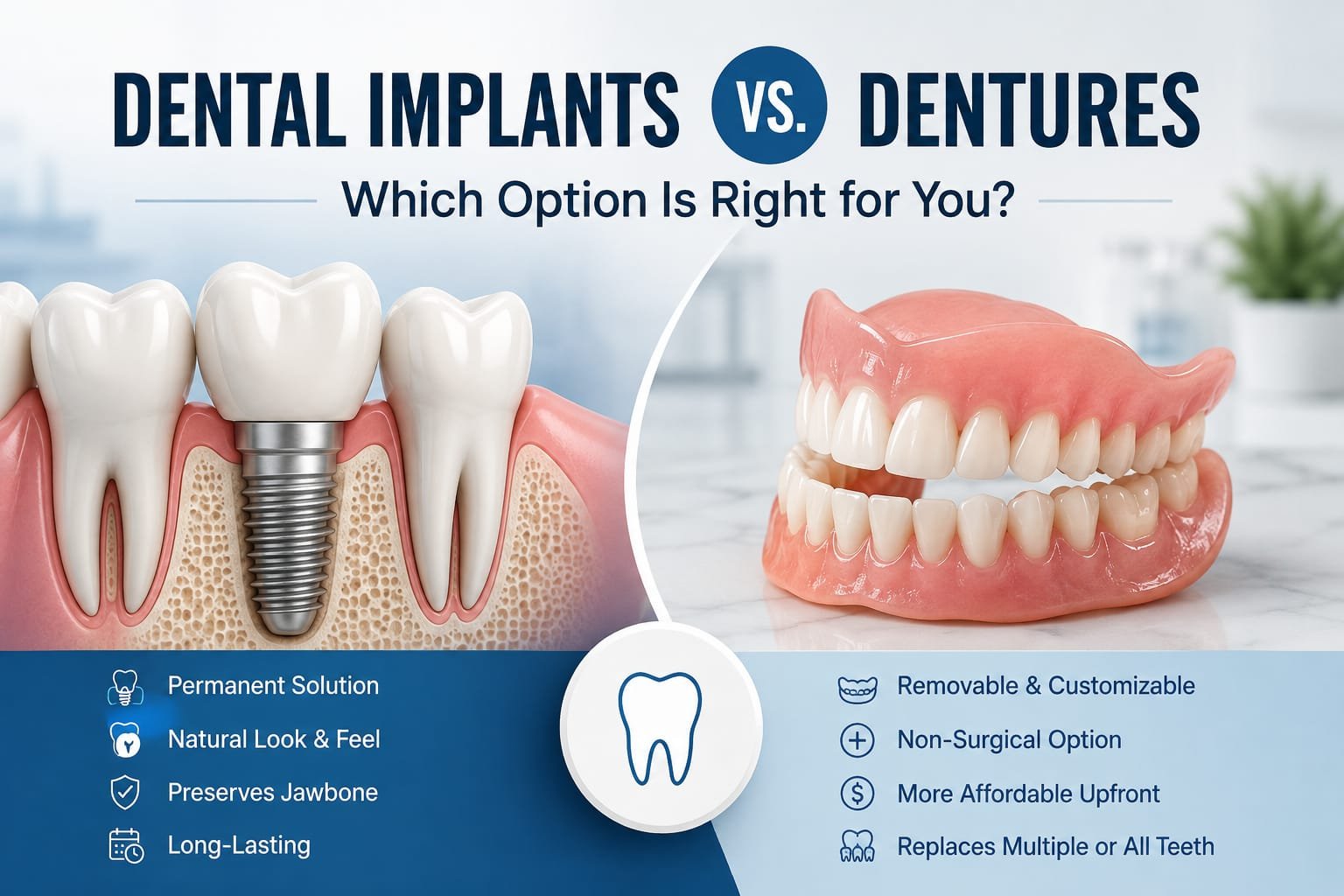
Losing one or more teeth can affect much more than your smile. Missing teeth can make it harder to chew, speak comfortably, and feel confident in social situations. Fortunately, modern dentistry offers several effective solutions for replacing missing teeth, with dental implants and dentures being two of the most common options.
But which one is right for you?
The answer depends on several factors, including your oral health, jawbone condition, lifestyle, budget, and long-term goals. In this guide, we’ll compare dental implants and dentures to help you understand your options.
What Are Dental Implants?
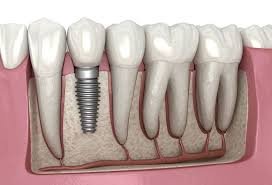
Dental implants are designed to replace missing teeth in a way that closely mimics natural teeth. An implant consists of a small titanium post that is surgically placed into the jawbone. Once the implant has healed and integrated with the bone, a dental crown is attached to restore the visible portion of the tooth.
Implants can be used to replace a single missing tooth, multiple teeth, or even support a full set of replacement teeth.
Benefits of Dental Implants
– Natural appearance: Implants are designed to look and feel like natural teeth.
– Long-lasting solution: With proper care, dental implants can provide a durable tooth-replacement option.
– Improved chewing: Because implants are securely anchored, they can provide excellent stability when eating.
– No removable appliance: Unlike dentures, implants remain fixed in place.
– Jawbone support: Implants can help maintain the jawbone around the implant site after tooth loss.
However, dental implants require a surgical procedure and a healing period. Patients also need sufficient bone and healthy gums, although additional procedures may sometimes make implant treatment possible for people with bone loss.
What Are Dentures?
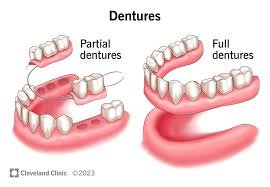
Dentures are removable dental appliances designed to replace missing teeth. They can replace several teeth or an entire arch of teeth.
There are different types of dentures, including partial dentures, which replace some missing teeth, and complete dentures, which replace all teeth in the upper or lower arch.
Benefits of Dentures
– Non-surgical option: Dentures generally don’t require implant surgery.
– Can replace multiple teeth: They can be used when several or all teeth are missing.
– More affordable upfront: Dentures are often less expensive initially than implant treatment.
– Relatively quick treatment: Depending on the situation, dentures may be provided without the lengthy healing period associated with implants.
– Removable: They can be taken out for cleaning and maintenance.
Modern dentures can be designed to look natural and provide a significant improvement in both appearance and function.
Which Option Is More Comfortable?
Comfort varies from person to person.
Because dental implants are fixed into the jaw, they can feel very natural once healing is complete. Dentures, on the other hand, are removable and may take some time to get used to. Some denture wearers may experience movement or discomfort, particularly if the fit changes over time.
A properly fitted denture can still be comfortable and effective, but regular dental visits may be needed to check the fit and make adjustments.
Which Option Is More Affordable?
Dentures typically have a lower initial cost than dental implants. However, cost shouldn’t be the only factor when choosing a tooth-replacement solution.
Dental implants may involve a higher upfront investment, but they are designed as a long-term solution and can help preserve the bone around the implant. Dentures may need adjustments, relining, or replacement as your mouth changes over time.
Your dentist can provide a personalised treatment plan and explain the costs for your specific case.
Are Dental Implants Suitable for Everyone?
Not necessarily. A dentist will usually evaluate your gums, jawbone, overall oral health, and medical history before recommending implants.
Patients with insufficient jawbone may sometimes require a bone graft or another procedure before implant placement. Maintaining good oral hygiene and following your dentist’s instructions are also important for successful treatment.
Can Dentures Be a Good Choice?
Absolutely. Dentures remain an effective option for many people, particularly those who need to replace multiple or all missing teeth.
They can restore much of your ability to chew and speak while improving the appearance of your smile. The key is having properly fitted dentures and maintaining good oral and denture hygiene.
So, Which One Is Right for You?
There isn’t one solution that is best for everyone.
Dental implants may be a good choice if you want:
– A fixed tooth-replacement solution
– A more natural tooth-like feel
– Greater stability while eating
– A long-term option and potential support for jawbone preservation
Dentures may be a good choice if you want:
– A removable solution
– A non-surgical approach
– A more budget-friendly initial option
– To replace several or all missing teeth
In some cases, patients may also benefit from implant-supported dentures, which combine dentures with dental implants to provide greater stability than conventional removable dentures.
Talk to Your Dentist Before Making a Decision
Choosing between dental implants and dentures is an important decision, and an online article cannot determine which treatment is right for you.
A dental consultation allows your dentist to assess your teeth, gums, jawbone, and overall oral health before recommending the most suitable option. They can also explain the expected treatment process, maintenance requirements, and costs.